• Rejected or didn't receive your confirmation email? Hit the Contact Us link at the bottom of any page to send us a message. We'll get you sorted. ~Jerk

I’ve switched camps.

I've only had windshields on three bikes. (Not counting the mostly useless sport fairings).

To go 65 or higher on the Interceptor, with the stock handlebars, was an isometric exercise. Pulling myself against the wind like I was halfway through a pull-up.

Like most of my other naked bikes, I've replaced the bars with something lower. The wind keeps my weight off my arms. But it's a trade off. It's almost a clip-on crouch.

There was a time when a 500 mile ride was nothing special. I replaced my old Bullet with the Interceptor specifically to take some long rides. To get to the great roads, in the far corners of the state, that I haven't been to in decades. Only to discover that 200 miles has become a long ride.

When I traveled I usually had a destination, but the highlight of each day were the twisty roads I discovered. My Harley Duoglides and a Harley wannabe, were my only big, comfortable bikes. They were not rewarding on a twisty road.

Most of my bikes have been mid-sized twins and thumpers of the standard or dual sport persuasion. And most of my rides have been in the canyons.

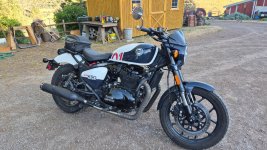
At 76, my Interceptor is close to perfect, for what I'm still capable of doing.
 
Last edited:
If I'd often take the highways I'd get myself a screen, though. Yes, the 650 Classic has no problems doing >130 kph, but I do.
Even at 100 kph (max speed daytime here) it soon feels I'm not sitting on my bike but hanging from the handlebars.

I'm not particularly tall (1m80), maybe I have a very big head that catches so much wind 😉
I don't like screens since I want to feel the elements when I am riding my SM 650. I avoid highways but if necessary my cruising speed will be around 110 kph.
 
I don't like screens since I want to feel the elements when I am riding my SM 650. I avoid highways but if necessary my cruising speed will be around 110 kph.
Neither do I - feeling the elements & 'smelling the cows' is a big part of the fun of riding a bike.
However it's difficult to fully avoid them here - we have a couple of rivers with only bridges for highways. Alternative is taking ferries or huge detours.
 
Probably the "laziest" bike I've owned was the iron barrel Bullet. Rides were low speed, and close to home. The sweet spot was 45 to 50 mph. Once I was in top gear, there was little shifting. (A bit like riding one of my old Panheads). Coming out of a turn and rolling on the throttle was oddly satisfying. There was no rush of power, just a steady pull of low end torque. You could practically count each exhaust note.

When I got the Interceptor, it felt like a rocket ship. How could anyone complain about the power? Of course, five years on, it's noticable wheezy when I want to pass a car in a short distance. But my days of passing everyone that gets in my way are long gone. In fact, I often get the impression I'm the only one going the speed limit. (Although I still speed up for the twisties).

I've clearly contracted Thumperitis. A debilitating disease that limits me to the lower end of the tach. Even a quick ride on my favorite roads seldom reaches 60 (96 kph). And I'm shifting back and forth between 3000 and 4000 rpm. My rides feel very casual, and very thumper like.

No windscreen tends to keep you more legal.;)
The wind blast definitely serves as a speed limiter. But it's the vibration that keeps me from getting pulled over. If I'm not tempting fate in a twisty canyon, l'm likely to be sedately motoring down a county road.

To me, the 6 speed gearbox seemed more like a marketing gimmick than a necessity. The wide power band (and the onset of Thumperitis) made the constant shifting annoying. A 16T front sprocket cured that, making the middle gears more usable. The bike's happy spot is around 3500 rpm. When I want to enjoy the road without keeping an eye pealed for the cops, I just put it in whatever gear keeps the speed limit around 3500 rpm. It's a vibration based form of cruise control. The motor starts feeling buzzy above 4000 rpm.
 
Last edited:
Probably the "laziest" bike I've owned was the iron barrel Bullet. Rides were low speed, and close to home. The sweet spot was 45 to 50 mph. Once I was in top gear, there was little shifting. (A bit like riding one of my old Panheads). Coming out of a turn and rolling on the throttle was oddly satisfying. There was no rush of power, just a steady pull of low end torque. You could practically count each exhaust note.

When I got the Interceptor, it felt like a rocket ship. How could anyone complain about the power? Of course, five years on, it's noticable wheezy when I want to pass a car in a short distance. But my days of passing everyone that gets in my way are long gone. In fact, I often get the impression I'm the only one going the speed limit. (Although I still speed up for the twisties).

I've clearly contracted Thumperitis. A debilitating disease that limits me to the lower end of the tach. Even a quick ride on my favorite roads seldom reaches 60 (96 kph). And I'm shifting back and forth between 3000 and 4000 rpm. My rides feel very casual, and very thumper like.


The wind blast definitely serves as a speed limiter. But it's the vibration that keeps me from getting pulled over. If I'm not tempting fate in a twisty canyon, l'm likely to be sedately motoring down a county road.

To me, the 6 speed gearbox seemed more like a marketing gimmick than a necessity. The wide power band (and the onset of Thumperitis) made the constant shifting annoying. A 16T front sprocket cured that, making the middle gears more usable. The bike's happy spot is around 3500 rpm. When I want to enjoy the road without keeping an eye pealed for the cops, I just put it in whatever gear keeps the speed limit around 3500 rpm. It's a vibration based form of cruise control. The motor starts feeling buzzy above 4000 rpm.
The gear ratios on the 6 speed seem close together with all the torque available. I would have preferred being spaced a little further apart for a lower rpm at freeway speeds.
 
The gear ratios on the 6 speed seem close together with all the torque available. I would have preferred being spaced a little further apart for a lower rpm at freeway speeds.
I bought the larger sprocket because first gear was too low. I was shifting into second as soon as I got the bike moving. It was a pleasant surprise to realize it spread out the shifts throughout the gears. The transmission went from annoying to don't think about it.
 
I bought the larger sprocket because first gear was too low. I was shifting into second as soon as I got the bike moving. It was a pleasant surprise to realize it spread out the shifts throughout the gears. The transmission went from annoying to don't think about it.
I always roll my eyes when I hear people say that all a bigger front sprocket does is drop the rpm’s at highway speeds. It affects every gear throughout the entire rev range. Around town I found that 3rd became much more useable. On the highway 6th becomes more of an overdrive gear. I also found on my Interceptor that I couldn’t make it through an intersection without shifting to 2nd. For my style of riding I’ve found that I prefer taller gearing on just about everything I ride.
 
In the past I've only put a larger front sprocket on two bikes. Both times to reduce the vibration at freeway speeds. On my old Harley it threw off the speedo, which ran off the gearbox.

On the SR500, I did it before a long trip. It worked fine for that, which was across the Great Plains, but when I got home, I had to switch it back to stock. The bike didn't have the power to pull the taller gearing going uphill.

... 3rd became much more useable. On the highway 6th becomes more of an overdrive gear...
I agree. I consider it the most important change I've made to the bike, after junking the OEM tires. On my favorite rides (in the canyons), I'm mostly in 3rd and 4th.

The stock gearing would make more sense if it were a high revving bike with a narrow band. Like a two stroke twin. Or a small displacement 4 cylinder.
 
Last edited:
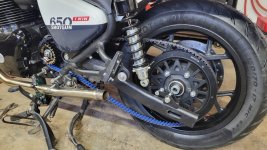
I heard those eyes rolling ;-) I absolutely agree with you and StefArmstg about the lower final drive ratio improving the overall feel and usability of the gearbox. The belt drive was also a big improvement over chain drive (imho).

View attachment 40123
If I had kept the Interceptor I would have gone with a belt drive. Not sure if I want one for my Classic. Seems like a lot money, and I’m not sure I would want the power loss on a 20hp bike.
 
What power loss is that? Just curious.
There is power loss from the engine to the rear wheel. Chains are the most efficient, only losing 2-4%. Belts lose 10-15%, and shaft drive is up to 20%. On a Classic the 20hp is measured at the crank, so actual power to the wheel is somewhere around 15-16hp. Add another 10-15% on top of that and it could start to feel real sluggish. Especially if you’re gearing it higher than stock.
 
There are different stories to be found on this (belt vs chain): some say a belt is even more efficient (being much lighter) 'proven' by measurements.

All I can say is I don't feel any loss or increase on my classic 650 after conversion (it feels a bit smoother though). And with its 46bhp that isn't exactly a powerhouse either...

Maybe I'm just too insensitive 😉
 
There is power loss from the engine to the rear wheel. Chains are the most efficient, only losing 2-4%. Belts lose 10-15%, and shaft drive is up to 20%. On a Classic the 20hp is measured at the crank, so actual power to the wheel is somewhere around 15-16hp. Add another 10-15% on top of that and it could start to feel real sluggish. Especially if you’re gearing it higher than stock.
Interesting. Most of the stuff I have seen show them to be pretty close, with both being above 90%. Shaft drives are the least efficient without a doubt, and have quirks that you have to get used to.
I have thousands of miles of experience with all three, and my personal choice is the belt.
 
Interesting. Most of the stuff I have seen show them to be pretty close, with both being above 90%. Shaft drives are the least efficient without a doubt, and have quirks that you have to get used to.
I have thousands of miles of experience with all three, and my personal choice is the belt.
Belts have a lot to recommend them, but my understanding is that you do lose more hp than with a chain. I honestly didn't know this was a point of controversy. Chains are a more direct link, while belts flex and tend to have bigger pulleys which leads to additional loss. More rotating mass. On most bikes, though, I think a belt is fine. And maybe 10% of 20hp isn't something you'd ever notice after the first ride. Except that it's only 8% because a chain already drops 2%. But belts are cleaner, quieter, have less maintenance, and last longer. That said, the loss of torque is very noticeable on a 350 just with a 16t sprocket installed. A belt with the same gearing would likely make it feel like a dog off the line.
 
Top Bottom